
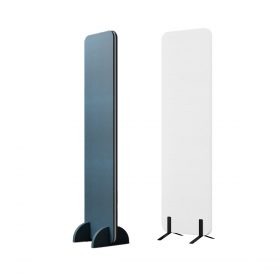
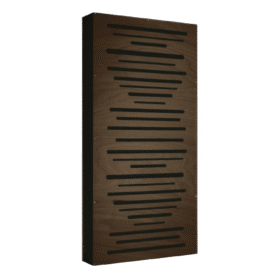

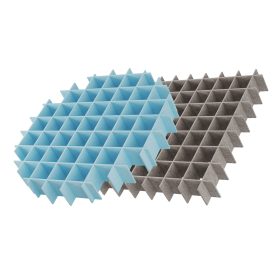

Echo and reverberation go away in one scenario: when the sound wave loses energy faster than the ear can catch its repetitions. In practice this comes down to three things done in parallel: absorbing reflections, scattering them, and controlling low frequencies. The room itself is described by RT60, the time the sound level takes to drop by 60 dB after the source stops. The lower the RT60, the shorter the trip from “sounds like a train station” to “sounds like a comfortable living room.”
Table of contents
Echo, reverberation, flutter echo: three different problems
These three often get lumped together, but in acoustics they have separate names because they need slightly different fixes.
| Phenomenon | What you hear | Where it comes from | Typical distance scale |
| Echo | distinct repetition of the sound | single distant reflecting wall | above ~17 m of wave travel (about 50 ms delay) |
| Reverberation | prolonged tail of the sound | sum of many reflections from walls, ceiling, floor | any room with hard surfaces |
| Flutter echo | rapid, ringing series of repetitions | parallel smooth walls close together | small rooms, corridors, bathrooms |
Where it comes from
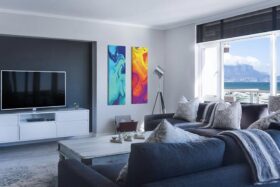
The most common culprit is a low ratio of soft surfaces to hard ones. Glass, concrete, plaster, tiles, laminated flooring, lacquered furniture fronts and smooth ceilings send most of the wave’s energy back into the room. Minimalist interiors, large glazing, open living areas and high ceilings pile more of those surfaces on. Low frequencies also build up in room corners, so even with a rug down and curtains hung the room can still boom.
The absorption coefficient (alpha) describes how much of the wave’s energy stays in the material and how much comes back. A value of 0 is an acoustic mirror, 1 is complete absorption. For typical surfaces it looks like this:
| Material | Alpha at 500 Hz | Alpha at 2000 Hz |
| Concrete, smooth plaster | 0.02 | 0.04 |
| Glass | 0.04 | 0.02 |
| Ceramic tile floor | 0.02 | 0.02 |
| Parquet, laminate flooring | 0.07 | 0.07 |
| Rug with underlay | 0.30 | 0.55 |
| Curtain in folds, dense fabric | 0.40 | 0.70 |
| 50 mm acoustic panel with wool | 0.90 | 0.95 |
| Corner bass trap | 0.80 (at 125 Hz) | 0.95 |
The gap between a bare wall and one with an absorber is an order of magnitude. That’s why the effect after the first few panels is so obvious.
How to tell what your actual problem is
Three quick tests cover it.
- The handclap. Stand in the middle of the room and clap once, hard. A “dzz” or “trrr” points to flutter echo between parallel walls. A long “shhhh” without distinct repetitions means reverb dominates. Separate “clap-clap” is classic echo.
- Speech test. Record a few sentences at different spots in the room on your phone and listen back. Where speech becomes unclear, RT60 is too long.
- Play a track with strong bass and walk slowly through the room. In some spots bass drops out, in others it booms disproportionately. That’s room modes, and it’s the sign that bass traps are needed.
Three pillars of effective treatment
Room treatment rests on three mechanisms. Each works in a different band and each has its place in the room.
| Pillar | What it does | Working band | Where to place |
| Absorption | removes reflected energy | mids and highs (from ~250 Hz) | first reflection points, ceiling |
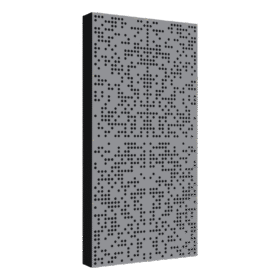
| Diffusion | scatters energy without absorbing | mids and highs | wall behind the listener, parts of side walls |
| Bass control | absorbs low frequencies | below 250 Hz | vertical corners, room edges |
Skip any pillar and the space feels wrong. Absorbers everywhere create a “dead room” where voices sound dry and unnatural. Diffusion alone doesn’t cut reverb. Bass control alone won’t tame harsh highs.
What you can do without buying panels
A lot of ground gets covered before any panel goes up. Each item below actually shortens the reverb.
| Action | Band affected | Scale of effect |
| Thick rug with underlay in the seating zone | highs, part of mids | large |
| Dense curtains folded across the full width of the window | highs, part of mids | large |
| Bookshelf on a bare wall | mid scatter | medium |
| Upholstered sofa, armchairs, throws, cushions | broadband mids and highs | medium |
| Asymmetric furniture layout, breaking parallel wall pairs | flutter echo | large in narrow rooms |
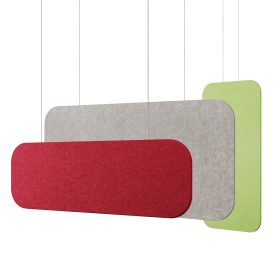
| Acoustic fabric on the ceiling above a desk or dining table | overhead reflections | medium |
| Potted plants in corners and next to glazing | scatter, mild damping | small, supplementary |
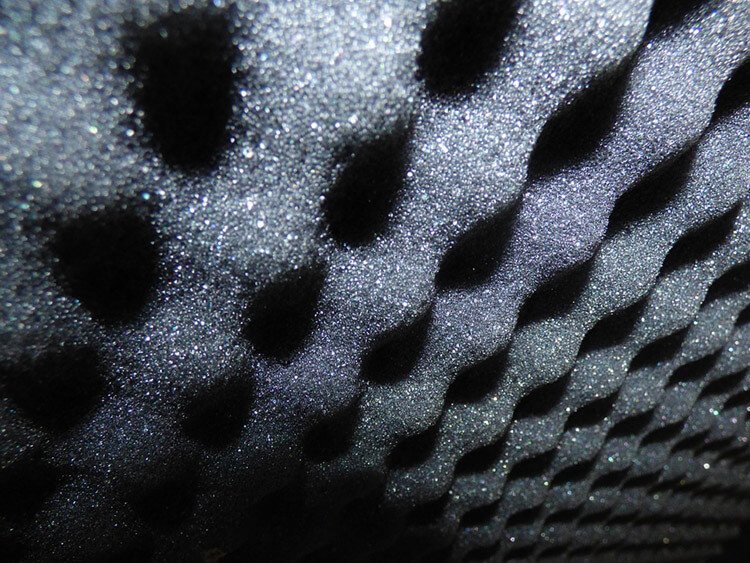
On the other side are the tricks that look promising but don’t measure well. Egg cartons, thin foam glued to walls, a lone picture in the middle of a bare wall. Foam 2 cm thick only starts working above 1 kHz, so speech and reverb stay essentially untouched.
When to reach for acoustic panels
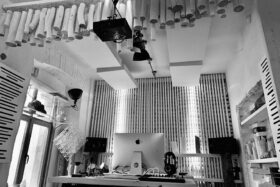
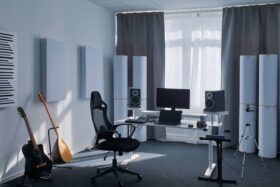
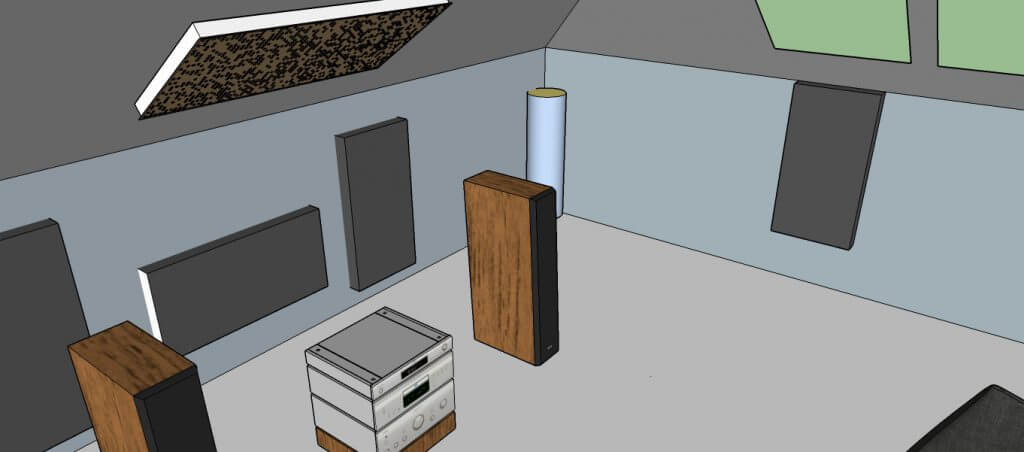
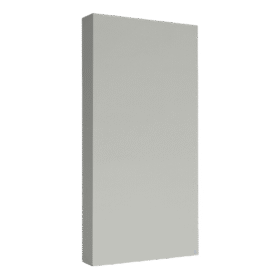
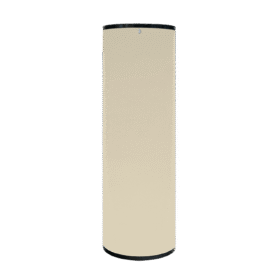
Textiles do a lot, but mostly at the top of the spectrum. When you need a predictable, measurable reduction in reverberation and a flat response across the full range, panels come in. Broadband absorbers 50-80 mm thick work from around 250 Hz upward; decorative mineral-wool panels are chosen for the specific band that’s problematic; bass traps target the low end and go in the vertical corners of the room (floor to ceiling), because that’s where bass has the highest amplitude.
Find first reflection points with the mirror method: someone slides a small mirror along the side wall while you sit in the listening spot. Wherever you can see the speaker cone or sound source in the mirror, that’s a location for an absorber. Same on the ceiling.
Most common mistakes in DIY treatment
The first is over-damping. A room covered in foam sounds unnatural, speech loses projection, music turns flat. The second is ignoring the bass. Wall absorbers alone bring down reverb in mids and highs, but the low end still booms and the balance feels wrong. The third is asymmetric treatment: panels on only one side wall, a rug covering only half the seating area, curtains on only one window. Room acoustics should be roughly symmetric around the listener’s axis, otherwise the stereo image and source localization fall apart.
10 steps that work quickly
- Full-width folded curtains on every large window.
- Thick rug with underlay in the seating or listening zone.
- Upholstered furniture and cushions instead of lacquered fronts.
- Bookshelf on a bare wall, ideally behind the listener.
- Acoustic panels at first reflection points on side walls and ceiling.
- Ceiling treated with absorbers or an acoustic cloud, if it’s smooth plaster or concrete.
- Break parallel surfaces with decor, slats, or by shifting a large piece of furniture.
- Bass traps in the vertical corners if you can hear boom.
- Go easy on foam. Overdoing it is easy.
- Verify the result with a handclap and speech recording before and after.
Working through this list in order takes a room from RT60 above a second down to 0.4-0.5 s, which is where conversation feels intimate, music sounds natural, and you don’t have to crank the volume just to catch a movie’s dialogue.