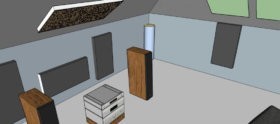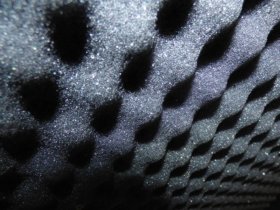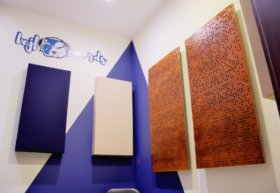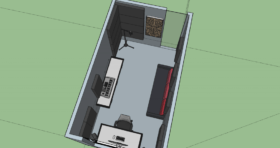



Reverberation time – it is defined as the time required for the acoustic pressure level to drop by 60 decibels after the sound source has been turned off, for example, after singing has finished, a recording has stopped, or instruments have been muted. Determining the reverberation time in a given room allows for the identification of its acoustic properties, as well as the introduction of potential adjustments in the arrangement, including the installation of acoustic treatments.
Reverberation time in rooms should vary depending on their purpose. Below are the recommended reverberation times in specific cases:
concert hall – between 1.7-2.1 seconds (larger ensembles require more reverberation, while solo performers need less);
music recording studio – 0.5-1 second;
opera – 1.3-1.6 seconds (with such reverberation, understanding speech is possible);
voice-over recording studio – 0.3-0.5 seconds;
director’s room in a recording studio – 0.2-0.4 seconds.
Several factors influence the length of the reverberation time, which are worth considering. Among them are:
frequency of acoustic waves;
shape and size of the room;
location of the sound source;
temperature and humidity of the air;
type of construction materials used and their arrangement.
Reverberation time also affects the clarity of sound at high frequencies. It is calculated based on the following mathematical formula (Sabine’s formula):
T = 1.161V / A
where:
T – reverberation time measured in seconds (s);
V – volume of the room measured in cubic meters (m³);
A – acoustic absorption of the room measured in square meters (m²).